
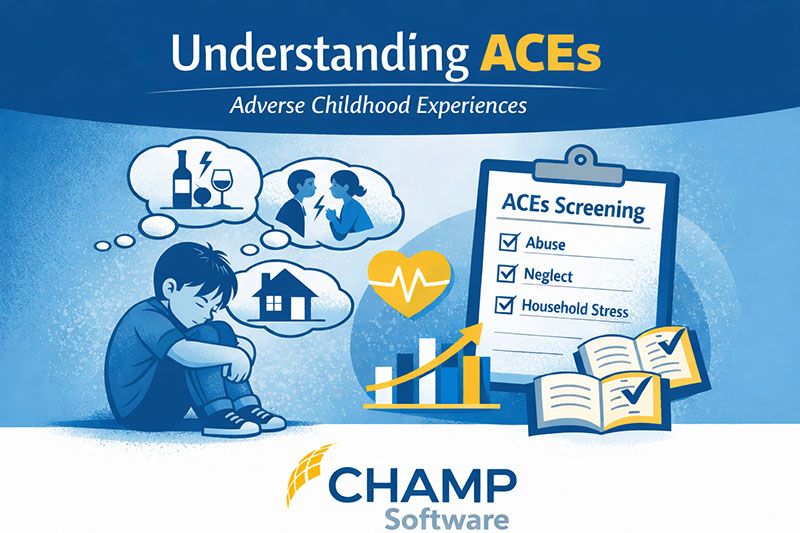
Overview: Understanding Adverse Childhood Experiences (ACEs) in Public Health
Public health agencies play a critical role in identifying and addressing the long-term impacts of trauma on individuals, families, and communities. One of the most widely used frameworks guiding this work is Adverse Childhood Experiences (ACEs)—a research-based model that connects early-life adversity to health outcomes across the lifespan.

Pulse Check Points
ACEs training helps public health agencies identify and address long-term impacts of trauma.
Adverse Childhood Experiences are traumatic events that occur before the age of 18.
ACEs came from a study showing a relationship between traumas experienced and negative health outcomes.
Nightingale Notes integrates ACEs screening, response and reporting.
Champ Software brings credible, research-based education to public health officials.
To support local health departments in this work, Champ Software is committed to delivering both education and practical documentation tools through Nightingale Notes, a cloud-based EHR designed specifically for public health practice.
As part of this commitment, Champ Software recently partnered with Zero Abuse Project to provide foundational training on the essentials of ACEs, helping public health professionals strengthen trauma-informed approaches while aligning education with real-world workflows.
ACEs Training Presenter: Caitie Dahl, Zero Abuse Project
The training was presented by Caitie Dahl, Forensic Interview Specialist and Trainer at Zero Abuse Project.
Caitie develops professional training materials and publications focused on forensic interviewing, child abuse investigations, and best practices for supporting children and families. She previously held multiple roles at First Witness Child Advocacy Center in Duluth, Minnesota, including Forensic Interviewer, Program Coordinator, Trainer, and Multidisciplinary Team Facilitator.
She holds a bachelor’s degree in psychology from the University of Wisconsin–Superior, with research experience in coercive interviewing, false confessions, memory, and suggestibility. Caitie is especially passionate about trauma-informed practice, multidisciplinary collaboration, and addressing the unique needs of LGBTQIA+ youth impacted by maltreatment.
Learn more about Zero Abuse Project and their national training and prevention work at
http://zeroabuseproject.org/
What Are Adverse Childhood Experiences (ACEs)?
Adverse Childhood Experiences (ACEs) are potentially traumatic events that occur before the age of 18. These experiences commonly include abuse, neglect, and household challenges such as exposure to violence, substance use, or mental health concerns within the home.
Extensive research shows a strong correlation between ACEs and long-term health outcomes, including:
- Chronic disease
- Mental health conditions
- Substance use
- Increased healthcare utilization
For local health departments, ACEs provide a public health framework for understanding how early-life experiences shape health outcomes at both the individual and population level.
A Brief History of ACEs Research
The ACEs framework originated in the 1990s through a landmark study conducted by the Centers for Disease Control and Prevention (CDC) and Kaiser Permanente. The original research demonstrated a clear, dose-response relationship between the number of ACEs experienced and the risk of negative health outcomes later in life.
Since that time, ACEs research has expanded significantly and now informs:
- Trauma-informed care models
- Prevention-focused public health initiatives
- Cross-sector collaboration among health, education, and social service agencies
Today, ACEs screening is increasingly embedded into local public health workflows, supporting early identification, prevention, and intervention strategies.
Documenting ACEs in Nightingale Notes
Education is only effective when it can be applied in practice. Public health agencies also need secure, standardized tools to document ACEs screenings, plan interventions, and track outcomes over time.
Nightingale Notes supports ACEs work by integrating screening and response directly into the EHR, allowing agencies to:
- Record ACEs screening results in a structured, compliant format
- Link screening data to evidence-based nursing interventions
- Monitor progress and outcomes longitudinally
Using the Omaha System, Nightingale Notes enables standardized problem classification, interventions, and outcome measurement related to ACEs. This approach supports consistent documentation, data-driven decision-making, and meaningful outcome tracking for ACEs-related care.
Learn more about how ACEs screening fits into public health workflows:
- Part 1: Adverse Childhood Experiences: Impact on Public Health
https://www.champsoftware.com/2025/11/25/adverse-childhood-experiences-impact-public-health/ - Part 2: Adverse Childhood Experiences and Their Impact on Long-Term Health Through a Public Health Lens
https://www.champsoftware.com/2025/12/02/adverse-childhood-experiences-and-their-impact-on-long-term-health-through-a-public-health-lens-part-2/
Supporting Trauma-Informed Public Health Practice
By partnering with organizations like Zero Abuse Project, Champ Software brings credible, research-based education directly to public health professionals—while ensuring that what is learned can be documented, tracked, and supported within the EHR.
This integration reflects Champ Software’s long-standing focus on:
- Public health–specific workflows
- Trauma-informed documentation
- Standards-based nursing practice using the Omaha System
As ACEs continue to shape public health strategy and service delivery, Nightingale Notes provides the infrastructure local health departments need to move from awareness to action—supporting education, documentation, and measurable outcomes in one secure, cloud-based system.
Learn more about Champ Software and Nightingale Notes at https://www.champsoftware.com