
Public health can do much to prevent and mitigate the impact of adverse childhood experiences (ACEs) on the health of people in their communities. They can educate about and screen for ACEs, including documentation of ACE scores in electronic health records (EHRs). And they can build capacity, integrate services and increase access to trauma-informed services for children and families.
What are ACEs?
According to the CDC, “Adverse Childhood Experiences, or ACEs, are potentially traumatic events that occur in childhood (0-17 years) such as experiencing violence, abuse, or neglect; witnessing violence in the home; and having a family member attempt or die by suicide. Also included are aspects of the child’s environment that can undermine their sense of safety, stability, and bonding such as growing up in a household with substance misuse, mental health problems, or instability due to parental separation or incarceration of a parent, sibling, or other member of the household.”
Background: The ACE Study
From 1995 to 1997, Kaiser Permanente collected surveys from 17,000 Southern California HMO members on adverse childhood experiences. More than half of respondents had at least one childhood exposure to traumatic events, a fourth of respondents had at least two childhood exposures to traumatic events, and there was “a strong graded relationship between the breadth of exposure to abuse or household dysfunction during childhood and multiple risk factors for several of the leading causes of death in adults.” (source) For instance,
“respondents who had four or more childhood exposures to traumatic events had multiple-fold increase risks for alcoholism, drug abuse, depression, suicide attempts, smoking, etc. “
ACE Study, 1998
The ACE Study “reveals that adverse experiences in childhood were very common, even in the white middle-class, and that these experiences are linked to every major chronic illness and social problem that the United States grapples with – and spends billions of dollars on.”
The ACE Pyramid
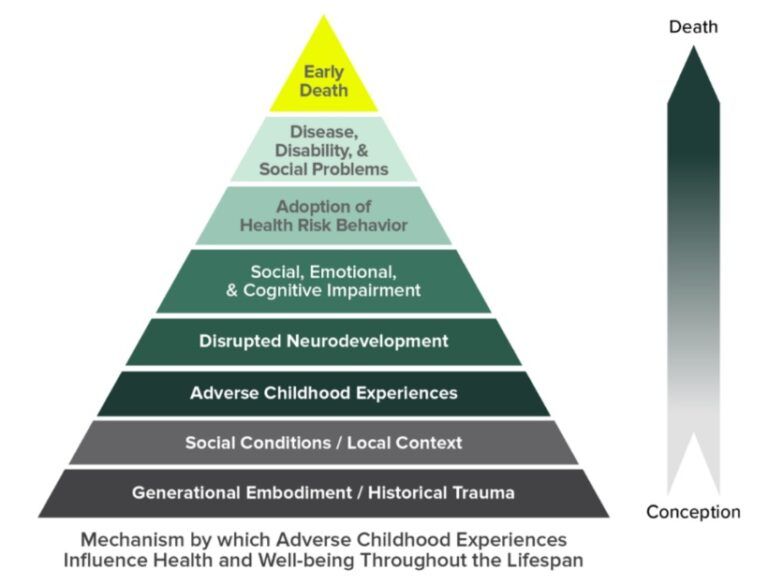
The CDC has said, “The CDC-Kaiser Permanente Adverse Childhood Experiences (ACE) Study is one of the largest investigations of childhood abuse and neglect and household challenges and later-life health and well-being.” The study showed a direct correlation between ACEs and long-term health, illustrated by the ACE Pyramid, below.

Image Source:
https://www.cdc.gov/violenceprevention/aces/about.html
The ACE Score
The number of exposures to adverse childhood experiences is often referred to as an ACE score. The ACE Study measured 10 different types of childhood trauma exposure. Those 10 types were chosen as the subject of the study because they were the types of trauma most commonly reported by a group of about 300 Kaiser members.
- Abuse
- Physical
- Emotional
- Sexual
- Neglect
- Physical
- Emotional
- Household Dysfunction
- Household substance abuse
- Household mental illness
- Domestic violence
- Parental separation or divorce
- Incarcerated household member
Get your ACE score, with a quiz on the ACESAware website.
What does the ACE Score Mean?
The ACE Study proved that people with an ACE score of four or higher have a much higher risk of chronic health problems later in life. ACES produce toxic stress in young brains, which actually alters the function of the brain, profoundly damages the immune system, changes how the body responds to stress, and impacts the entire body which leads to long-term health consequences. ACESTooHigh reports that, “ACEs cause much of our burden of chronic disease, most mental illness, and are at the root of most violence.”
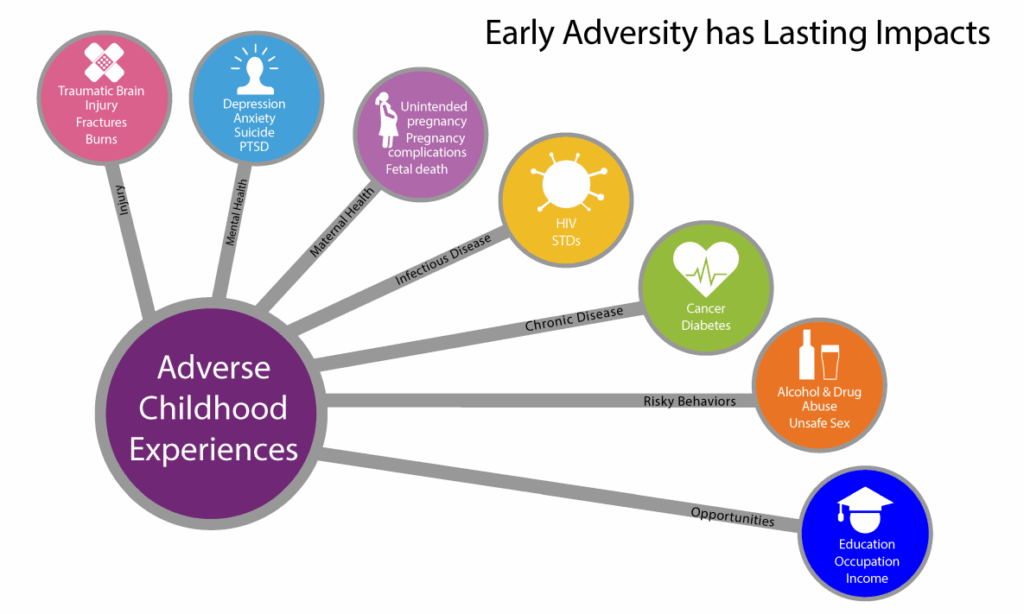
Illustration from “About the CDC-Kaiser ACE Study” on cdc.gov.
Dr. Nadine Burke Harris’ TedMed Talk about ACEs impact on health over a lifetime is a plea to confront prevention and treatment of childhood trauma:
However, the ACE score is only meant to be a guideline or indicator and is not an absolute predictor of future health. In fact, many mitigating factors can come into play, most significantly, resilience.
Resiliency
According to ACESTooHigh, “Resilience generally describes the bounce-back ability of individuals who return to the similar shape, form and condition after misfortune, harm or injury.”
Protective factors – such as a safe environment, nurturing relationships, stability, knowing you were loved, knowing someone cares, and having a stable person to turn to – can all strengthen a person’s resilience.
The Minnesota Department of Health describes Resilience:
“Resilience is the ability to bounce back from challenges and get through stressful times. It is a skill that can be developed and strengthened through positive experiences and connection to family, friends, teachers, and community. These things can all be considered protective factors. No child is magically resilient or invulnerable to ACEs, just as no individual child is doomed in the face of ACEs. Resilience must be cultivated and continuously supported. ”
What can public health workers do?
Public health can mitigate the effects of ACEs, prevent them from being passed from one generation to the next, and intervene before they occur. Consequently, this type of upstream intervention can change the long-term overall health of a community.
Dr. Robert F. Anda, MD, MS, one of the developers of the original ACE Study, provided some practical ways to do this during an address in Minneapolis in 2011.
- Education: Public health workers can educate the community at large and policy-makers on ACEs and their effects.
- Creation of a standardized terminology: In addition, public health workers can help create a standardized terminology for addressing and assessing ACEs so that the prevalence of ACEs, interventions used to address them, and outcomes of those interventions are measurable, communicable, understandable, and repeatable.
- Document need with population-based or surveillance surveys: These are useful for obtaining funding and political support. Importantly, surveys also assist with program planning and evaluation and surveillance helps maintain focus and momentum.
A Public Health Approach to Child Maltreatment and other ACEs is suggested by the Childhood Adversity Narratives in a 2015 presentation.
- Screen for ACEs in systems that serve children and families
- Build capacity to prevent and treat child trauma
- Increase access to trauma-informed services for children and families
- Integrate and enhance programs to target synergistic ACEs with highest cumulative risks
- Integrate trauma services across family-serving systems
Public health workers can use an electronic health record (EHR) with Omaha System
Public health workers can document their work using an electronic health record (EHR) with a fully-integrated, standardized terminology. The Omaha System is recognized by the American Nurses Association since 1992. The Omaha System is in use in 96.5% of Minnesota counties.
As an example, Nightingale Notes EHR by Champ Software fully integrates the Omaha System so that any piece of data put into the system can be reported on and outcomes can be documented.
Tools and Resources for Addressing Community Health Through Trauma-Informed Care
References
Secginli, Yas, Illhan, Olsen, “Investigating Adverse Childhood Experiences and Nutrition and Physical Activity Behaviors Using the Omaha System” Mar 2022. https://pubmed.ncbi.nlm.nih.gov/34590983/
Drakowski & Anderson-Berry, “Rethinking healthcare’s approach to ACEs treatment and the role of social health programming” Feb 2025. https://www.nature.com/articles/s41390-025-03970-w
Centers for Disease Control, “A Public Health Approach to Adverse Childhood Experiences” Oct 2024. https://www.cdc.gov/aces/php/public-health-strategy/index.html
The Omaha System. https://www.omahasystem.org/
National Child Traumatic Stress Network. “Beyond the ACE Score: Perspectives from the NCTSN on Child Trauma and Adversity Screening and Impact.” https://www.nctsn.org/sites/default/files/resources/special-resource/beyond-the-ace-score-perspectives-from-the-nctsn-on-child-tauma-and-adversity-screening-and-impact.pdf
Burke-Harris, Nadine, “Ted Talk: How Childhood Trauma affects Health Across a Lifetime” Sep 2014. https://www.ted.com/talks/nadine_burke_harris_how_childhood_trauma_affects_health_across_a_lifetime
Putnam, F., Harris, W., Lieberman,A., Putnam, K., Amaya-Jackson, L. “Childhood Adversity Narratives: CANarratives” 2015. https://www.pacesconnection.com/g/aces-in-pediatrics/fileSendAction/fcType/5/fcOid/449978856659790836/fodoid/449978856659790835/CANarratives.pdf
Center for Disease Control, “About the CDC-Kaiser ACE Study” https://www.cdc.gov/violenceprevention/aces/about.html